Back to school! Or not. . . Usually there is a lot of excitement about the return to school, if for nobody but the parents. But this year it’s all shrouded in uncertainty. What is the right thing to do, send them or not? Parents and teachers are asking this everywhere because of the Covid 19 virus. And there are no easy answers, and there are strong opinions on each side of the equation. We all want things to be normal, especially for our children, but who knows what is right?
My Daughter and Son-in-law went through the tough decision process and wrestled with sending my grandson to the first grade, an important milestone. At the end-of-the day, we are doing virtual first grade on a computer with his teachers, with myself being his school master. For all of us, it seemed the safest thing to do for the little guy. Besides, I am convinced he can learn more than in the actual classroom–but the challenge will be keeping him on task at Pop pop’s (my) house, which is usually a fun zone (and not all that disciplined). Maybe it’s because his Pop Pop is all about fun and is not all that disciplined – anymore.
Tough decisions. Life is full of them. Some matter. Some others, not so much. But the pandemic has forced us into decisions we never ever thought about before, or could have dreamed six months ago that we would have to face: To go to school; to play college football; to wear a mask or not; to avoid crowded venues; to eat in at your favorite restaurant; to go to the Dentist. Our new reality is a bitter pill to swallow for many. Maybe science will save us, and not religion. After all, church is a mighty dangerous place these days, at least in person.
But here is the truth why we want to send our kids to school: We like the security of knowing. And if we go about business as usual, then at least things seems normal and that is comforting. There are so many unknowns, so many unforeseeable implications, and so many uncertainties. We all want our kids in school, it’s the way things are supposed to be and we take comfort in that return to the routine, the expected, the normal. Yet we can’t be sure it is the right thing.
And maybe we need college football for the same reason- to let us know at the deepest level our society is really OK. We want this pandemic to be over, heck it’s been since March now, and we can only take so much uncertainty.
The truth is, we have never been comfortable living on the street called ambiguity. We are drawn toward the sure, the certain, the absolute. We like our religion to be ambiguity free as well, we want to know and we want to be sure. Dogmatic beliefs based on propositional theology where the Bible is a rule book will always sell, it puts our shaky lives on firm ground. But that foundation might only be slippery sand when the unpredictable visits our house. The problem has always been, but especially obvious now, that every single day is an uncertain one. And we recoil as a people and as society at the insecurity unpredictability brings. So we at least want to put on the façade of normalcy, and maybe we can fool ourselves into thinking that it is so. It does feel good for a while, until another dose of reality catches up with us and slaps us around.
So where does God fit in during a pandemic? It’s a good question. It appears like there is no divine intervention on the horizon, no miracles, although I am sure many individuals would testify to the veracity of such in their own lives. But it seems that the pandemic must run its course, and whatever hope there is lies in science.
But a funny thing happened in the midst of the storm. Even though most all churches and houses of worship are closed, 24% of Americans have said their faith has grown during the pandemic and only 2% said it has become weaker according to a new Pew Research Center Poll.
So maybe God is busy doing what God does—working on our souls, reminding us that when God seems far away, God has really not gone anywhere. Maybe we are the ones who have done all the moving, who knows. And maybe we are the ones he tasks with taking care of the rest. For me and my house, I remember a favorite old hymn:
When darkness hides His lovely face I rest on His unchanging grace In every high and stormy gale My anchor holds within the veil
On Christ the solid Rock I stand All other ground is sinking sand All other ground is sinking sand
So for all who crave certainty, where are you standing? As for me, I’m standing with science and keeping our first grader out of school. But I’m also standing on Christ, church or not, a sure foundation, especially now when everything seems like sand under our feet. He has held me up more than once in a crisis. And that is a sure thing.
I guess by now, most of us are used to grabbing for the mask when going out in public. Many states now, including Arkansas, have some sort of mask mandate when in public. So more and more people are wearing them at the grocery store, gas station, Walmart, and really anywhere where they are likely to contact people. Now I know, no one likes wearing a mask. Especially in the summer in Arkansas, where the sweltering temperatures make the mask all that more uncomfortable.
The truth is, science tells us that by wearing a mask we help slow and prevent the spread of disease. As more and more states promote face masks as a way to control the spread of COVID-19, the top-line message has been: wear a mask to protect others. While it’s true that most face masks are more effective in preventing you from launching droplets into the air than breathing in already dispersed droplets – that doesn’t mean masks offer no protection to the wearer.
It’s likely that face masks, by blocking even some of the virus-carrying droplets you inhale, can reduce your risk of falling seriously ill from COVID-19, according to Monica Gandhi, MD, an infectious disease specialist at UC San Francisco. “The more virus you get into your body, the more sick you are likely to get,” she said.
Yet still, there are those who simply will not wear a mask. It infringes upon their “freedoms.” But wearing a mask is not about you. You might think it’s worth the risk to not wear a mask because you aren’t afraid of catching the disease. But in reality, it’s about the other guy, the other gal. Wearing a mask means, “I care about you. I choose not to infect you if I have a disease that I’m not even aware of.” So refusing to wear a mask might be the ultimate in selfishness. But then again, no surprise, we are a selfish lot.
The truth is, we don’t like to be told what to do. Especially by the government, or “Big Brother,” or anyone else. We are fiercely independent as Americans. But in this case, not wearing a mask may be to our detriment and to the detriment of society as a whole. It’s kind of ironic really. Last year, if you wore a mask into a gas station you would likely raise suspicion as you would look criminal. Now, if you don’t wear a mask you raise suspicion, and you still might look criminal. So my 65 year-old diabetic self will wear a mask.
But even when I take it off, I still wear a mask and think nothing of it. You see, we all wear many invisible “masks” in our day-to-day encounters, even with those closest to us. No one knows us completely, and we try to hide our true selves, even when we look in the mirror. Getting behind the image we project as our “ideal self” and seeing our true selves is the hallmark of emotional health. Yet it is more difficult to see than wearing a wool face mask in the summer heat.
Maybe nowhere are “masks” more prevalent than in religion. Religion can hide a myriad of things. We appear one way on Sunday, but are a different human come Monday morning. We have all heard the argument about too many hypocrites in the church. And there are, of course. But the truth is we all wear masks, even after we think we have taken them off. The word “hypocrite” is rooted in the Greek word hypokrites, which means “stage actor, pretender, dissembler.” So think of a hypocrite as a person who pretends to be a certain way, but really acts and believes the total opposite. Hypocrites usually talk a big talk but fail to follow their own rules — like an outspoken vegetarian who secretly eats bacon (from vocabulary.com). In ancient Greece, actors in the theater were only male. There were no elaborate sets or costumes, and the few actors on stage would change parts by simply changing masks. Thus, the Greek beginnings shed light on the word hypocrite– hiding behind a mask.
Religiously, Wayne Oates in his book, Behind the Mask, describes eight personality disorders, and specifically their religious expressions. Our various religious “mask” are used to hide who we really are. We use religion to cover up our defects of character, wearing masks, as it were. The trouble is, we are not fooling God, and can only fool ourselves for so long. The real us is behind the mask, waiting for a crack in our armor to assert itself, sometimes in less than opportune times.
As we strap on our masks to go out into public, may we pause to look at our faces in the mirror- what is the real me all about? What masks are my favorites to hide behind? What are the ones I wear and don’t even realize it? Admittedly, nobody wants to see all of the real Stan (not even me, Stan) but it might help if I face up to the man in the mirror every once in a while. Hard as it can be, it’s the only route to authentic change.
I pray for the day when we will no longer need masks- physical ones for sure, but also emotional/spiritual ones. Or as the Apostle Paul said in 1 Corinthians 13:12, “For now we see in a mirror dimly, but then face to face. Now I know in part; then I shall know fully, even as I have been fully known.” This kind of self-awareness might benefit more than our neighbor- it might save our very own souls.
After visiting Ft Morgan in Alabama last week, I realized that I don’t know much about the War of 1812. So I found a crash course video on YouTube to catch up a little bit. Now I’m an expert, I guess– lol. But in the process, I wondered what ever happened to my old history teacher in high school, Mr. Abney. I wasn’t sure if he was still alive or not, after all it has been over 40 years, so I googled to find out. Indeed, Mr. Abney is 89 years old and living in Tennessee. But what I uncovered next was a shocking surprise to me. His son Keith, my age, my very best childhood friend growing up died just last month. We were inseparable until about the 10th grade. I saw his obituary by accident- I had no idea. Keith was a physician in Tennessee, and I deduce from the obit that he had cancer. Now I haven’t really kept in touch with him since early college days, but still he was a significant friend. Couple that with the fact that my best friend in high school is also dead. Ted, a brilliant engineer, died about 20 years ago. It was untimely and way too early for Ted and his young family. He had brain cancer.
I recently saw on my high school Facebook page (for the class of 1973), that more than 20 people have passed away out of our small class of 164 at Searcy high School. And I guess in the next 15 years probably 50 or 60 more will likely pass away, at least from a statistical average standpoint. It’s a sobering thought. I certainly don’t want to be counted in that number, but who knows. I’m an insulin dependent diabetic who has had a heart attack. I suppose one has to come face-to-face with their own mortality. And I am reflecting on mine after losing dear friends, albeit from long ago.
While I am not in the mood for a life review just yet, it doesn’t hurt to inventory ones accomplishments, failures, dreams, and legacy once in a while to see what goals are still obtainable, and what things might be fixed. I sometimes don’t think of myself as all that old. But life has a way of reminding me. I was checking out in Walmart the other day and I was loading the bags into my cart. The young cashier quickly grabbed one of the bags I was lifting and put in my cart. She said, “it’s heavy honey, we are in no rush, let me help you.” I said “thank you,” and told her she was very kind. The bag was not that heavy, but I must have looked ancient to the 19ish year old cashier. I guess part of aging gracefully is learning to accept help, whether you need it or not.
Oh, there are benefits to maturing. I don’t care very much what people think about me anymore, and I am much more assertive than I ever was. Hey, I don’t have to go to work- I’m retired, and that is pretty freeing. I recently purchased a lifetime fishing license for $20, and a lifetime National Parks Pass for $80. There are some pretty sweet deals out there for seniors. I just wish someone would explain the best Medicare choice for me!
I am much more in tune with nature now. I pay attention to birds, to clouds, to the weather. Yes, I can watch The Weather Channel for hours! I live more simply, and I appreciate beauty much more– wherever I find it. I can’t take excessive noise, angry people, greedy people, or unkindness in any form. I recoil at watching anything violent on TV. I like to cook, and I’ve never been a homebody, but I am more so now. I like to occasionally enjoy a good cigar, and to hell with any risks associated with such a behavior. Relationships are more important that material success, and I am really jealous of no one. I have learned to practice the Zen art of “presence” and I try to savor the “now.”
Father Richard Rohr in his book “Falling Upward” give us some insight about the second half of our lives, and gives us a framework for a spirituality of such. It is must reading for anyone who is on the downhill slope of life. Jim Finely writes this about the book: “This book invites us to see how God is moving us from doing to being, from achieving to appreciating, from planning and potting to trusting the strange process in which as we diminish we strangely expand and grow in all sort of ways we cannot and do not need to explain to anyone, including ourselves.”
Christianity, for many, offers solace from the fear of our own mortality. But for many it comes with a catch: If you are in “the club,” you live forever in a mansion and walk on streets of gold. But If you can’t recite the formula, well then, some believe you will be damned and tortured forever and ever amen in the belly of Hell. So it would behoove us to get it right. But that’s the rub isn’t it? My childhood friend and his family basically believed that because I was baptized after my profession of faith and not before, I was in danger of hellfire. Really? Come on man!
I guess age has done something else for me, and that is this: It has liberated my theology and has flipped the boundaries between the sacred and the profane. If we believe that God is love, how can we believe that he will damn you forever for not reciting formula that not everyone has heard or agrees on. How can God love you and send you to hell for not properly stroking what we believe is his enormous ego? He has to create lesser beings to worship him in order to be satisfied. How can God hold us accountable eternally for a few years of sinning on earth, sins by the way, that the Bible says we cannot help but commit because we were created (again by God) that way. We reduce God to a capricious and vindictive God, and in fact all of our metanarratives about the afterlife are either militaristic or materialistic and I dare you to find those characteristics in Jesus the Nazarene. But oh yes, he loves us. So if you live to be 78 years old, you can burn for eons upon eons for choices you couldn’t help make because you were born defective. I don’t think so.
I do believe that we are in need of saving, but not from hell, or maybe not just from hell. For many, especially seniors, hell arrives early. Living every day with chronic pain, chronic diseases, increased depression, fatigue, loneliness and grief takes its toll as the losses pile up.
At the end of the day, I do take comfort in the hope of Eternal life. I take no comfort in that it might not be for everyone. But I mostly take comfort in the message of Jesus Christ and his kingdom. The kingdom ethic is revolutionary: Love one another; Love your enemies because anyone can love a friend; Go the second mile for people when you are only expected to go one; Turn the other cheek when someone wrongs you; Always forgive. Jesus thought people are more important than rules. He taught that reconciliation is job one. He said that the least are the greatest, and the poor are most blessed. For citizens of his kingdom, humility is the defining trait. Peacemaking is just as important.
These Kingdom values are important enough to get one through the second half of their life- or the first half if you want a head start. Just put Jesus and his kingdom in your life review, and you are on your way.
“Does my father know I’m here?” “What time will my father come and pick me up?” A reasonable question that anyone might hear, but not if it’s from a 93 year old woman whose father died 65 years ago. As you might surmise, the woman in question is my mother-in-law who has advanced dementia. Ironically some years ago, I led a support group for Alzheimer’s Arkansas at the hospital, and I did so for a couple of years. I went through their training, and I led a number of groups. I now wish I had paid more attention to my training and the stories of the people in the group, now that dementia has made its abode at my house. My mother-in-law has had dementia for most of the 11 years that she has lived with us, but it has become severe in the last year or two. And as anyone knows who’s gone through this, it’s tough on a lot of levels: The constant questions, i.e. the same thing over and over again. Then there is the endless rummaging through her purse for her keys, her billfold, her glasses, her whatever. That is when she is not saying “where is my purse” some 30 times a day. “Where is Boyd?” She constantly wonders about her husband who died 11 years ago, and she asks about him maybe twenty times a day, sometimes repeating the refrain as quick as 30 seconds apart. Then there is the caring for all of her needs physically. My wife is the daughter we all hope we have someday. I always heard pity the seniors who had only sons. But the hardest part is watching the once vibrant, energetic, never-sit-down woman with a big servant’s heart become frail mentally and now also physically.
The Apostle Paul said in Romans chapter 12, that we are transformed by the renewing of our minds. I guess Paul was the first cognitive therapist. He is right, of course. What we feed our minds is realized in concrete ways in our lives. But what if our minds are no longer being renewed? Well, that is evident as well. A decaying mind transforms the whole person. It affects one mentally, emotionally, and in the end- physically.
But what about spiritually? That was the Apostle Paul’s business after all. I am here today to say, that Alzheimer’s cannot touch us spiritually. And it’s because we are more than body, we are more than mind, and we are more than feelings. We have a soul, a spirit.
In ancient Greece, Plato details Socrates arguments for the immortality of the soul in what may be his greatest work, Phaedo. One of the main themes in Phaedo, is the idea that the soul is immortal. In the dialogue, Socrates discusses the nature of the afterlife on his last day before being executed by drinking hemlock. Socrates had been imprisoned and sentenced to death by an Athenian jury for not believing in the gods of the state and for corrupting the youth of the city. So he outlined four classic philosophic arguments for the immortality of the soul, arguments that are still debated today.
It seems that the Greeks recognized that we are not just a duality of body-mind, but we have something else-something different- a soul that is immortal, that can survive even death. That was the context for the arrival of one Jesus Christ in a Hellenistic influenced world, who came to establish his Kingdom on earth and to save our souls in the process. For many, the essence of the gospel message is that even though we die, we can live forever. So being a Christian births hope. And though we grieve the loss of the body and mind, we do not grieve as those having no hope.
If the soul is indeed immortal, and if it can be saved as billions of people across religious lines believe, then I believe this is true:
Dementia cannot touch the soul.
Dementia cannot rob us of our essence.
Dementia cannot change who we are.
Dementia cannot cancel what is important.
Dementia does not have the final word- Dementia can hijack our life on earth, but not in heaven.
And for the 5 million Americans living with dementia; for the one in three seniors who will die with the disease; for the 305 billion dollars the disease costs our country every year; for the 18 billion hours (yes billion) of caregiver hours of care each year (see Alz.org), at the end of the day, this is good news. The fact that the soul lives on, untouched, is about as Good News that one finds in the Gospel of Jesus Christ. The apostle Paul again says it best: “Therefore we do not lose heart. Though outwardly we are wasting away, yet inwardly we are being renewed day by day.” 2 Corinthians 4:16.
Did you hear the one about the man whose bathtub was overflowing? He decided he better do something about it, because his house was flooding, and someone who lived with him wasn’t too happy. So he went and got a bucket and mopped and mopped as hard and fast as he could – but to no avail! The room was still flooding. So he went to the store and bought a bigger bucket and a bigger, newer, and better mop. He even got a friend to help him mop up, two are better than one after all; but the bathtub kept overflowing and flooding his house. It seemed the harder he mopped, the behinder he got. He finally went and took an online class on how to be a more effective mopper, and he then googled how to get rid of water in your bathroom. Man, was he well prepared to beat this thing now. However, his bathroom was still flooding. “I know what I’ll, do, I’ll hire a consultant.” After that failed to produce any change, he decided to take a two day workshop in a faraway place on how to be a more effective mopper and how to keep your bathroom clean. But to no benefit, his bathroom was still flooding. He then formed a committee to study the problem, but you already know how that went. Ah, he thought: I’ll go buy a shop-vac– it’ll suck that water up in no time. But at the end of the day, he was losing the battle and his house was really being flooded. Finally it occurred to him he had to get to the root of the problem and not just try some sort of fix. Starring at it the whole time, he realized that the answer had been as plain as the nose on his face– So he reached over and turned off the faucet, and opened the bathtub drain.
OK, that is a silly story that would never happen in real life, but sometimes our most persistent problems have an answer as plain as the nose on our faces. You see the truth is, we have to get to the root problem, and quit treating the symptoms. We just need to drain the tub. Sometimes it’s what we don’t see on the evening news that is a key to what we do see on the evening news. Maybe we need to quit treating the symptoms and look deep within for our most pernicious problems in our society.
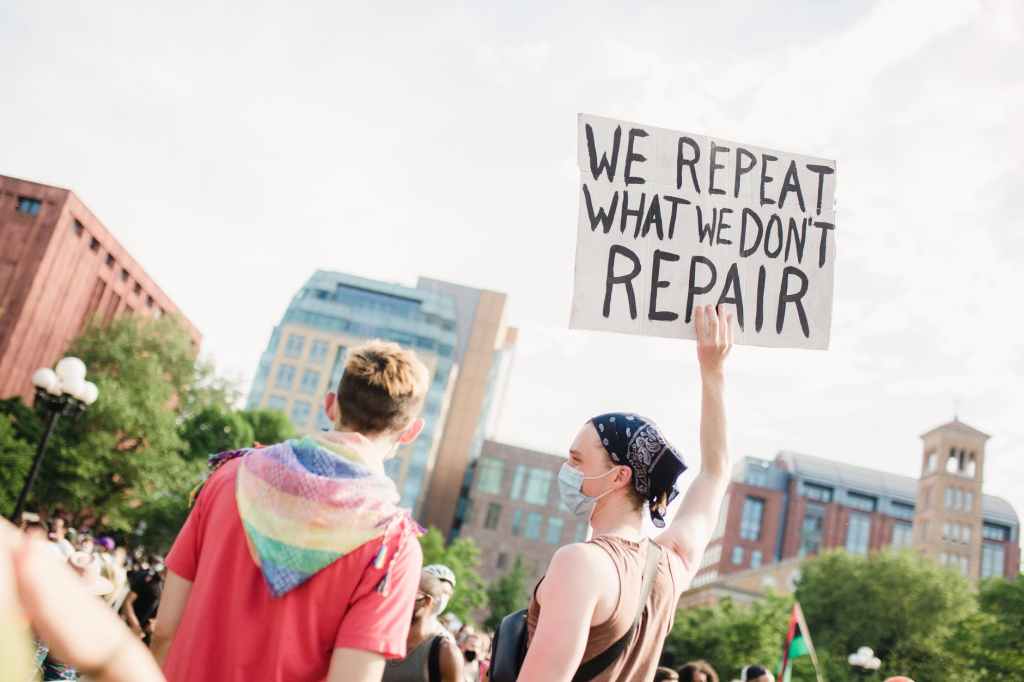
Unless you have been living in a cave, you know of the racial tensions in our country, and the rising Black Lives Matter Movement. For me as a white male, I now somewhat understand the concept of white privilege, but honestly it took me a long time to get to this point of acceptance. I never felt privileged- but more importantly I never felt the Black man’s plight- not in the least. And that is because I view life through a privileged filter when it comes to people. I have a hard time looking out my window and only seeing my world- the world according to Stan.
It seems to me we have a number of solvable problems in race relations in this country. But we have not solved many of them, not 46 years after the Civil Rights Law, or 145 years after the 13th Amendment. Those laws were clues that we as a society were broken, at least some recognized that, and that’s a step, but they didn’t deal with the root problem: prejudice.
Prejudice is the window that colors our world. Prejudice is the fuel that feeds our ignorance and our fears. Prejudice is indelibly ingrained deep inside our psyches at a very young age. Prejudice is the most insidious, most cloaked, and often most dormant force that hides in our souls. Oh, prejudice is a learned behavior to be sure, but it incubates effortlessly in our fallen human hearts. Prejudice- you sometimes have to uproot a lot just to even know that it lives in your heart.
Religion has been my business for 44 years, and we talk a good game in the church. We are for social justice, we are for reform, we preach against racism from our stained glass sanctuaries- you know those places of worship which hold the most segregated meeting of the week. We give money, we may even join a peaceful protest. I’m here to say that is not enough. We have a spiritual, not a religious problem as humans. It is our hearts people—and if you look deep enough, no matter how small, prejudice lies in your heart, even if latent, it’s waiting to devour you and I like a lion, the first moment we are vulnerable. And that is a spiritual problem.
I am reminded of the well-known parable of the Good Samaritan. It is an iconic parable of Jesus that represents his ministry and mission in a nutshell, so we really ought to forget all the church stuff and pay attention here. You know the story: A good Jew was traveling along the road when some robbers came along and beat the tar out of him leaving him in a bad way. He needed help worse than Donald Trump’s hair stylist. But wait! Thank God a holy man was coming along, a priest who probably just finished doing some priestly business. He was the best of religion. How lucky could an unlucky man get! But the man walked on by.
Holy smokes, who would have thought it! But then a second man, a Levite, who was just a little lower than a priest in the religious order of things, was tooling down the road. He too, walked on by lick-ity split. Surely all hope was lost. But then came a Samaritan- a hated Samaritan. You see, there was great hatred between the Jews and Samaritans of Jesus’ day. The victim probably thought he was coming by to finish the job. Bad luck comes in threes, everybody knows that. But the Samaritan did not walk on by. In fact, he came through for the guy in a big way. He doled out compassion like nobody’s business in a way that even those aforementioned two good people could not comprehend.
The point is, that what we do is more important than what we say or even believe. It more important than what we preach or teach. You see, that heresy of belief is no match for heresy of practice. The priest and the Levite were not bad people. They were the best people that came to Jesus’ mind for the story, and that’s the shocker. But loving our neighbor means putting teeth behind our words. Love comes from the heart- a changed heart. Loving our neighbor is a radical component in the Kingdom of God, and in case you are wondering, our neighbors include a lot of people that we wouldn’t dream of walking across the street to speak to, let alone go out of our way to help. For the Kingdom of God is made up of such neighbors. Who is our neighbor? It’s that person that you deep down dislike, hate, resent, fear, or just prefer to avoid for reasons that you can’t even verbalize.
If the Samaritan teaches us anything at all he teaches us to not hate but to love and to serve. The truth is Jesus wants to fix our hearts, and a big part of that is putting into practice his ethic. Jesus said to love your enemies, to do good to those who hate you, to bless those who curse you, to pray for those who abuse you. Jesus taught us to react to those who strike you on the cheek, by offering the other also, and from those who take away your cloak, not withholding your coat as well. To go the second, mile when you are only required to go one. And to refrain from being judgmental, to give to everyone who begs from you, and of those who take away your goods, do not ask them again. And as you wish that others would do to you, so do to them.
Prejudice is a problem of the heart, and until we get that right, we will not get anything right in race relations. We begin by turning to the one who changes hearts, who births us anew. When we give our hearts to the Jesus of the gospels, and seek his kingdom and ethic, we have the chance to change society- beginning with us. We are able to let his law of love rule our hearts and minds, no matter what.
Black Lives Matter, it is easy to say for us progressive white folk- of course they do! But if you saw a black man on the side of the road needing help, maybe in a part of town where you feel like you wandered into and don’t belong, what would you do? Would you walk on by, submitting to that prejudice that’s looking for a crack in your psyche to breech. Or would you do what a citizen of the Kingdom of God always does: Love your neighbor, as yourself. If you choose to walk on by on the other side of the road, you have missed the boat on what Jesus was all about, period. There is nothing else. And frankly if that’s the case, you may have missed eternal life. May it not be so- it’s not too late. Turn off that faucet; and unplug that drain.
After going over all of his school lessons, and teaching my grandson everything that I know and even some stuff I made up, I eventually got around to telling him some Bible stories to entertain him, and well, to maybe learn a thing or two. He loved them. As per usual, I got in over my head with his questions, even on a topic that I consider myself to have considerable knowledge. It is also tough finding Bible stories that are G-rated, especially in the Old Testament. I told him about David and Goliath, a classic, but hey, in the end somebody gets killed! Explain the righteous God in that one to a six year old. I told him about Jonah and being swallowed by the whale, but it sure was hard explaining why he was swallowed by the whale in the first place, and why he was spit back up. Finally, I thought I would give up telling him stories and show him something cool I played an excerpt from a YouTube video from TheTen Commandments movie, where Moses parted the Red Sea. He did indeed think it cool, but it sure raised a lot of questions. So I told him we could watch the whole movie and I would try to explain what was happening in the story to him. He and I both lost some interest when I told him the movie was about five hours long, or something crazy like that. And the movie, of course, raises a lot of questions- maybe not for my grandson- but certainly for me.
Now this classic movie is scripted, so all those hard heads who say that it is not Biblical or true to the Bible need to get over it. The show is story, it is drama, and it gets the point across. There is plenty of reading between the lines, but hey, we all do that when we read scripture anyway- it’s called interpretation, and that is why there are so many different beliefs about the same text. We all add stuff to its reading. We can’t help it, we can’t escape our own bias.
I do love the movie “The Ten Commandments.” I like the drama and my favorite line in the movie is when the children of Israel are backed up to the Red Sea and Pharaoh is in hot pursuit with his chariots and mighty army. Brenner smirks with great irony, “The God of Moses is a poor General, that he leaves no retreat.” I guess Pharaoh, on the other hand, was a genius when his troops followed the children of Israel into that sea that parted right in front of their eyes. Now come on people, if you have been through the plagues, and you now saw the sea part, no way you are going to mess with those people or their God. You are simply going to find some weak heathens on the way back to Egypt to capture and enslave. The Israelites were bad karma, let those people go dude and forget about them. Of course, the Children of Israel had their own faith issues. They had seen the God’s deliverance first hand, and after Moses was gone a few days too many, they started worshiping a cow they made out of gold themselves, for heaven’s sake. People. Go figure.
In reality there are a lot of questions about many of the Bible stories. I will never forget going to seminary and learning about the International Critical Commentary of the Bible, written more than a hundred years ago by mostly scholars from Oxford and Cambridge, and it changed the way I saw scripture. You can access them online for free. Now, they are difficult, tedious reading at best. I had a lot of education about the scientific method in my collegiate background, and you would think the Bible, being true, would hold up to such scrutiny. And in a word, not to burst anyone’s bubble, the concept of the Exodus just doesn’t hold up to science.
And I say this mainly for these reasons: There are no historical accounts outside of the Hebrew Scriptures. There is no archeological evidence that has ever been discovered to support the Exodus. I mean two million people wandering around in the desert for 40 years and no pottery shards or artifacts from such a civilization? Especially in a land where the conditions are ripe for everything being preserved forever. There are pottery shards and arrowheads in every field east of Little Rock (left behind from much smaller groups of native Americans) that wash up after every heavy rain. There are not indicators in the vast scholarly field of Egyptology that refer to Moses or a mass Exodus of slaves. According to Exodus 12:37-38, the Israelites numbered “about six hundred thousand men on foot, besides women and children,” plus many non-Israelites and livestock. Numbers 1:46 gives a more precise total of 603,550. The 600,000, plus wives, children, the elderly, and the “mixed multitude” of non-Israelites would have numbered some 2 million people,compared with an entire Egyptian population in 1250 BCE of around 3 to 3.5 million. Two million people would be larger than almost all modern American cities, there is no evidence of such large populations in this period of history. Marching ten abreast, and without accounting for livestock, they would have formed a line 150-200 miles long (no kidding, do the math). No evidence has been found that indicates Egypt ever suffered such a demographic and economic catastrophe or that the Sinai desert ever hosted (or could have hosted) these millions of people and their herds. The International Critical Commentary has a field day with numbers on the Old Testament BTW. Archeologist, even those of the faith have labeled the search for artifacts around the Exodus as a fruitless pursuit. The route of the Exodus is also problematic from a geographical perspective. Where is this “Red Sea” anyway?
And there are a number of anachronisms in the story itself which point to a context closer to 600 – 800 BC rather than the date required to fit Egyptian domination, such as the names of the cities listed, the fact that dromedaries were listed and they were not introduced into Egypt until much later, and so forth. The consensus among biblical scholars today is that there was never any exodus of the proportions described in the Bible,and that the story is best seen as theology, a story illustrating how the God of Israel acted to save and strengthen his chosen people, and not as history.
So did the Exodus really occur? Who knows? It seems unlikely that it occurred on the scale in which it is reported, but is certainly possible on a smaller scale, and we all know that numbers were often symbolic in scripture. And besides, it was a very long time ago; there was no CNN to cover the event. But that is not the point. God’s story of liberation and salvation is the point. But we sometimes think that the whole thing stands or falls on the historicity of the entire Bible. I have heard preachers say “if one part of it isn’t true, then none of it is true.” If the world was not created in seven literal days, then it is all false people say. If there was no talking donkey, or a giant, man swallowing whale, or kid killing a giant with a slingshot, then it is all rubbish some believe. They really do throw out the baby with the bathwater.
So what about Jesus? There is some evidence about Jesus in extra biblical sources. And shortly after the first century, there was an explosion of accounts by his followers. Heck no one in the history of the planet has more written about them. There is debate about some of the miracles of Jesus. There are many New Testament Scholars who believe that many of the passages of the gospels were added by the post resurrection followers of Christ who were editorial revisionist. Again, I don’t know.
But here is what I do know: I don’t care about the Exodus or even Jesus turning water into wine—actually I kind of like that one, glad he did it. If they prove that Jesus wasn’t virgin born, so what? I will still believe because for me the gospel is communicated in the stories, not in the historicity of the events themselves. And as such their truths are applicable to our very own life events; they are relevant to our context, and thereby are not culturally encapsulated paradigms.
So where does my faith come from? Great question! But make no mistake, it is there. A large portion no doubt comes from tradition, and the faith of my parents before me. I am fully aware that if I had been born in another place, another time, or another context my faith would be very different or maybe non-existent. Yet, I still have faith.
Some of my faith comes from superstition. Some from guilt. Some from fear. Some from shame and the need to be punished or forgiven. Some from the need to see the wicked get their due. Some from the need to believe that someone, somewhere, is keeping score for all the injustices in the world. Some of my faith is magic, some is rubbing the lucky rabbits foot. I know all of this, yet, I still have faith.
At the end of the day, some of my faith comes from spirituality or spiritual awareness. You just can’t explain some things. Faith is often at odds with reason, it sometimes makes no sense. And in fact, having faith sometimes is downright foolish. When I consider other faith systems that I think are ludicrous, when it boils down to it, they are really no different from my own on some level. Yet I still have faith.
So where does my faith come from? It comes from experience. Personal experience. It comes from my life and the lives of others and from the lessons of history. The proof for me, is in my own life. Just ask the Apostle Peter, went from a coward who denied Jesus to a hero on the day of Pentecost. I have seen radical transformation in my own life and the lives of others. I have seen the transforming power of living the Kingdom ethic, of practicing the law of love, of the blessedness of being a peacemaker, And the purpose and direction that my life has because of faith. And more powerfully, this same story is replicated throughout the annals of history and the gospel stories and the history of Christianity.
The truth is I know Jesus lives and was raised on that third day not because of archeological or historical or scientific evidence. I know he lives because I have seen in my life and the lives of many the light that pierces the darkness. I believe because of the darkness that is in human history. I believe because of the dark corners of my own life. I believe because I have seen the light of the resurrected Jesus showing us the way. I have seen that the moral arch of history is long but it has been bent toward justice. I have seen the power of love and nonviolence. I have seen the transformation of lives that comes from the authentic love of Jesus Christ. I have seen love conquering all. I have seen the most recalcitrant souls transformed, and we all know how hard change is for any of us. I have seen things come and go, but the story of Jesus Christ endures. And that is why I have faith.
Do I believe Jesus “loves me this I know for the Bible tells me so”? Maybe. But this I know- I do believe because my life tells me so. As does the lives of the saints I have been blessed to know—personally, and through the stories in the Bible and church history.
I must have been an advanced child. You see, I never went to kindergarten. Oh, they had it way back then (uh, 60 years ago), but I didn’t go for some reason. I went straight to the first grade! I must have missed a few things though, as best-selling author Robert Fulghum reminds in his classic book, All I Really Need to Know I Learned in Kindergarten. It could be, that I missed a few of those lessons, and that would explain a lot. Well, these past few months trying to go over my grandson’s schoolwork, who happens to be in kindergarten, has definitely shown me that I don’t know a lot of things. Like how to teach a kindergartener. It’s hard, man. My hats off to teachers. Now mind you, I have taught numerous classes in college and Master’s level students in seminary. But a six year old? It was a challenge. I thought I had A.D.D., but I’m a rookie compared to a kid! I also know nothing about discipline or structure. I might also be lazy.
So this got me thinking of all those life lessons I missed by not going to kindergarten. Surely missing those is haunting me now on some level. I hope and pray that my grandson didn’t miss any of those critical life lessons by having his PopPop teach him instead of a professional. Thank God for the iPad and Google Classroom and ABCMouse! Technology may have saved my keister. And Thankfully my grandson is extremely bright and knew it all anyway. Must take after his MiMi and not me.
But to be honest, I may have learned more from his Kindergarten experience than he did. You might say, “it’s about time Stan”; or “better late than never Stan”; “or you can teach an old dog new tricks Stan. ” And you wouldn’t be wrong. Because I have learned a lot this spring.
I have learned these lessons from my grandsons: Kids want to learn, and have a natural curiosity. And they learn in a myriad of ways. I was at first concerned about “screen time” with their devices, they are after all, a convenient baby sitter. But they have learned a lot for the many educational videos and cartoons that are on platforms such as “YouTube Kids.” My two year old grandson will wow you with his knowledge if you listen to him. My kindergartener is non-stop questions. My impatient self wants to tell him (and sometimes does), to put a lid on it, to give it a break, but that’s for my benefit and not his. He really is thirsty for knowledge. And the day is coming all too soon when he will not want to ask me anything. So be patient and encourage those questions!
Kids need acceptance and unconditional positive regard. They crave your approval. Heck, we all crave approval. As an adult you are their world. Nothing is better than making them your world too.
Kids want to have fun and laugh when they learn. That is job one for them. They want to have fun! What’s wrong with that? As an aging adult, it’s hard to have fun at times. We could certainly learn from that in this all too serious world. I am cognizant of the fact, that I have to work at not be becoming a grumpy old man. Nobody can help with that goal like a child.
Kids have a way of understanding what is important. Or maybe better, who is important. And what is more critical than that?
Kids do best when they learn in a context of love. This context is the difference between success and failure. Not only while they are a child, but in the future too.
And what about me? I have learned more about myself than I imagined. Now, some of these lessons I have been confronted with before now, some many times, but nothing like learning them afresh from a little guy that is honest and straightforward in his thoughts, and even in his criticisms loves you to the core.
I have learned that I need to be way more patient. I am patient enough to get by, but not patient enough. Like I said, my hats off to all the school teachers, they have a very hard job. They deserve our utmost respect.
I have learned that I need to better understand what tough love is. There is no easier manipulation than a grandchild pulling the heartstrings of a grandparent. It is way too easy for them, and they are pros at it from very early on. We have to remember that there’s some things that have to be done for their best interest, whether they like it or not, we like it or not, cooperate with it or not, or pitch a fit about it or not. The truth is, they are loving and forgiving, and will think no less of you if you are tough in a loving context.
I have learned that I need to be okay with being inconvenienced for the sake of others. At our core, most of us are best at looking out for ourselves. There are things I would rather do that be emotionally beat up by a six year old who doesn’t want to cooperate. But none of the things I want to do are as important in this short season of influence. I can waste all my time as I wish in a few years.
I have learned that I need to have the same intentionality with kids that I had in business for 36 years. The skills that made me successful and the ones that were necessary for me to do my best in work also apply when doing much more important work, that of helping my grandchildren. “To Do” list-check. Daily schedule-check. Introspection and self-evaluation-check. Mission statement-check. Intentionality-check. Performance appraisal-nah, never liked them. Paycheck-priceless.
I need to really listen, like I taught hundreds of others to do all those years. I taught about the diagnostic, supportive and therapeutic functions of listening, and guess what? The stuff works on kids too. (Also see being more patient above).
I need to never fail at being Christian in my talk and actions to the littlest and least. It’s way too easy to lose your cool around kids. I am a big man in my grandchildren’s eyes, and I need to be consistent and worthy of that admiration. After all, I need to never forget that I am someone who is very important’s hero.
What lessons have the kids in your life taught you? It’s worth pondering. Jesus said in Matthew 19:14: “Let the little children come to me, and do not hinder them, for the kingdom of heaven belongs to such as these.” And I for one, believe him. If you don’t, just talk to a kindergartener.
Mark 12:28-3428One of the scribes came near and heard them disputing with one another, and seeing that he answered them well, he asked him, “Which commandment is the first of all?” 29Jesus answered, “The first is, ‘Hear, O Israel: the Lord our God, the Lord is one; 30you shall love the Lord your God with all your heart, and with all your soul, and with all your mind, and with all your strength.’ 31The second is this, ‘You shall love your neighbor as yourself.’ There is no other commandment greater than these.” 32Then the scribe said to him, “You are right, Teacher; you have truly said that ‘he is one, and besides him there is no other’; 33and ‘to love him with all the heart, and with all the understanding, and with all the strength,’ and ‘to love one’s neighbor as oneself,’ —this is much more important than all whole burnt offerings and sacrifices.” 34When Jesus saw that he answered wisely, he said to him, “You are not far from the kingdom of God.” After that no one dared to ask him any question
As you probably know, our governor, Asa Hutchinson, has been holding Daily Press conferences on the state of the CoVid19 virus in Arkansas. Of course, he has had a lot of questions about trying to reopen the economy in the state of Arkansas, an unpopular move with many people. I don’t know what is right, I can understand the arguments both ways. On one side, some noted experts like Dr. Fauci believe it’s far too soon to get back to business as usual. On the other side, one can’t deny that people are hurting as they are without work millions have lost their jobs. Subsequently some are in danger of losing their homes and perhaps can’t even feed their families. So the ability to return to work is very critical to the well-being of our society. Our governor said that it doesn’t have to be either health and Wellness or our economy as we have to measure both. That we have to balance our sense of safety and security with our economy and financial well-being. It can’t be “either/or”, it has to be some of both in a measure response.
The “both” makes sense to me. Maybe it’s because I like having my cake and eating too. I often don’t know which extreme to side with, but the “both” seems like a practical experiment to me. The trouble is, we live in an increasingly divided world, a world where “either/or” reigns supreme in our thinking. You are one or the other. You are a conservative or a liberal. You are either a Hatfield or a McCoy, a Capulet or a Montague, an Ali or Frazier, a Trump or a Pelosi, a democrat or republican, or a conservative or a liberal.
“Either/or”. In this age of bipolarization with sharp dividing lines, it is becoming and either/or world. I remember having to read some of Kierkegaard’s first work, Either/Or. Talk about some lite reading! Kierkegaard published it with a fake name which translates “violent Hermit,” which should have been my first clue. I got to thinking that maybe I should have put a fake name to some of my sermons, like that one where I slammed the doctrine of the Trinity. And I wouldn’t even have to name myself violent hermit, as Stanley is a Celtic name meaning “the hermit who lives under the bridge.” Too late I guess. I will own up to my stuff. Kierkegaard’s two volume book outlines a theory of human existence, marked by the distinction between an essentially hedonistic, aesthetic mode of life and the ethical life, which is predicated upon commitment.
Either/Or portrays two life views. Each life view is written and represented by a fictional pseudonymous author, with the prose of the work reflecting and depending on the life view being discussed. For example, the aesthetic life view is written in short essay form, with poetic imagery and allusions, discussing aesthetic topics such as music, seduction, drama, and beauty. The ethical life view is written as two long letters, with a more argumentative and restrained prose, discussing moral responsibility, critical reflection, and marriage.The aesthetic is the personal, subjective realm of existence, where an individual lives and extracts pleasure from life only for his or her own sake. In this realm, one has the possibility of the highest as well as the lowest. The ethical, on the other hand, is the civic realm of existence, where one’s value and identity are judged and at times superseded by the objective world.
In simple terms, Kierkegaard surmised that one can choose either to remain oblivious to all that goes on in the world, or to become involved. More specifically, the ethic realm starts with a conscious effort to choose one’s life, with a choice to choose. Either way, however, an individual can go too far in these realms and lose sight of his or her true self. Only faith can rescue the individual from these two opposing realms. Either/Or concludes with a brief sermon hinting at the nature of the religious sphere of existence, which Kierkegaard spent most of his publishing career expounding upon. Ultimately, Kierkegaard’s challenge is for the reader to “discover a second face hidden behind the one you see”in him/herself first, and then in others. A good point, and if I had read the end first, I would have saved myself a lot of deciphering grief. Sadly, there was no Google in my seminary days.
The polarization of America, if not the world, is increasingly reduced to the “either/or”. With seven billion persons on the planet, I think it ridiculous to force them all into “either/or” paradigms, but it is happening. The haves and have nots is the oldest “either/or”, and the lines of demarcation are growing worldwide. And it is happening in religion as well. You are saved or not, catholic or protestant, Christian or Muslim, religious or spiritual. And maybe Kierkegaard was on to something, only faith can save us from “either/or”.
In the Gospel of Mark, chapter 12 Jesus says to the scribe in verse 34, “you are not far from the kingdom of God.” Not far? What the heck does that mean? Aren’t you either a child of the king or one of the world? Are you not saved or lost? Are you not headed to heaven or headed to hell? My whole Baptist heritage is based on either/or salvation. Not far? And this is not the first time Jesus has indicated degrees of righteousness. He once told the Pharisees, the religious icons of the day who were generally good people, that Sodom and Gomorrah would be better off in the day of judgement than them. Better off? Not far? He also said to the crowd, “unless your righteousness exceeds that of the scribes and Pharisees you will not see the kingdom of God.” Exceeds? He said to the Pharisees that tax collectors and harlots would enter the Kingdom of God before them. Before? I am pretty sure that Jesus wasn’t an “either/or” person.
A lot of you grew up like me, in an “either/or” culture. At church it was simple, you are either going to heaven or hell. That’s it, period. And you were for us or agin’ us. Of course, the Catholics in town had a work-around with purgatory. But hey, we Baptists thought they were simply in the going to hell camp. And so were the Church of Christ, simply because they believed in Baptism before being saved, and except for a little piano music were very much like us “saved” Baptist. Now understand this: both groups believed in Jesus and sought to serve him, both groups believed in Baptism, but because of the interpreted order of events, one was going to live in mansions on streets of gold and the other was going to be tormented in the literal fires of hell forever and ever amen. Really? Com’ on man. Stay in school Arkansans. That’s “either/or” degenerating to its logical end.
I am truly afraid that “either/or” thinking will be the end of everything we hold dear. It will run amuck in an already divided society where race and religion are its anchor points. You are on our side or not. You are friends or enemies. We fail to see the foolishness of “either/or” in a pluralistic world that has in fact organically grown on diversity and multiplicity.
You see, it can’t be an “either/or” world because we live every day in the gray. Jesus knew that, and he knew that the ultimate “either/or” people were the highly religious: Exhibit A, the scribes and Pharisees. Yet one scribe came who understood that the law of love was the most important commandment, and Jesus says, “you sir, are not far from the kingdom of God.” Not far.
When we allow our prejudices to control our lives, we are either/or people, and friends we are far from the kingdom of God. When we fear our neighbors, the exact opposite from the greatest commandment, we are far from the kingdom of God. When we only see things as my way or the highway, we are far from the Kingdom of God. When we think that we have the corner on truth, and everyone else is wrong, we are far from the Kingdom of God. When we believe that we are better than everyone else, heck better than anyone ese, we are far from the kingdom of God. When we see everything as either right or wrong, pretty or ugly, acceptable or unacceptable, or as black or white, we are far from the Kingdom of God, no matter how much Bible we know, how often we go to church, or how orthodox our doctrine may be.
But getting close to the kingdom of God? It’s easy and it’s in Mark’s gospel. It’s not what we think, it’s not what we believe, you heard me, it’s not what we are passionate about, it’s not even how we behave– it is how we love God and how we love our neighbors. Because when we authentically love the Lord God with all our heart, all our mind and all our souls and we love our neighbors as ourselves, we then, and only then, are not far from the Kingdom of God. The law of love is the most important thing to our faith, not anything else, and certainly not the myriad of things that divide us, or any of those walls we have fortified between “us “and “them”. Love alone frees us from a world hopelessly trapped in the “either/or”. And anytime we are liberated from our human limitations, that’s Good News, because at the end of the day there is hope for the world, and maybe we are in fact worth saving. And the whole planet comes one notch closer to the Kingdom of God.
I look for variety in my reading, it suits my A.D.D. better. I just finished a short book I really liked called Zen: A Simple Path to More Happiness, More Tranquility, and Less Problems, by Andrew Daley. However, Daley also wrote a book called, “Control Your Brain Like a Puppet,” so I’m not so sure about him. I’m more concerned with my brain controlling the rest of me like a puppet, so give me a book on that, Daley. While Buddhism is attractive on many levels, I am not tempted by Buddhism as a religion, as I don’t really get the point. But I very much am attracted to it as a life philosophy. I mean heck, who doesn’t want more happiness, more tranquility and less problems? I liked the book so much I decided to read the classic Tao Te Ching. They are both easy reads, but to internalize what they are saying you have to take your time to absorb the meaning, and for the western mind, probably reread it over a few times, as it is a different paradigm to wrap our mind around.
But a healthy dose of Zen may be what we all need in this day of stay-at-home and social isolation. Zen is about simplicity, about transcending your circumstances, about living in the present, about mindfulness and intentionality. Zen is simple, optimistic, positive in it approach, and calmness and tranquility are supreme values. Zen tells us to slow down, to be patient, to see and hear the now, to practice “presence.” Zen flourishes in a decluttered life, which is what got me interested in it to begin with, I read that book on decluttering your space. It is organized and disciplined, but relies on trusting your feelings in an experience. Ego takes a back seat, in fact its kicked out of the car, and humility is an obligatory virtue. Of course meditation, or prayer if you prefer, is a key tool in one’s Zen toolbox. Moderation is important in the balance of Zen, as extremes from both polarities are its enemy. That appeals to the moderate in me. Zen is about experiences and not possession, it is about transcending and that is not acquiescing, about controlling what you can control, and that is always and often only your reactions to your circumstances.
Come to think of it, Jesus message would be at home with Zen philosophy. His teaching, preaching, and examples are textbook mindfulness in action. Jesus’ concept of the coming Kingdom of God would not be out of place at a Buddhist prayer, uh meditation meeting. His teachings are in alignment with everything that I have said about Zen this morning, and if you don’t think so, read about his life and work in Matthew, Mark, Luke and John, with those filters in place. Look for it.
So why all the Zen talk? I am more present focused that at any point in my life, especially since I have more past behind me than future ahead of me, and my goals are greatly simplified to basically be as healthy as I can be, to invest in my family, and to be the best version of myself I can be. I want to slow my life down. Now you say, come on Stan, you’re retired, you are slow enough buddy. Where is that “type A” approach to life that used to assert itself on occasion? By slowing down, I mean I want to get the most out of today, by being present in every simple thing, and find joy in every minute of the day. There can be no better day for me than today, I refuse to mark time of to look forward to something better in the future.
Regardless of what some have said, Jesus was not about pie-in-the-sky-by-and by, but was all about living in the present. Jesus tells us to be “ready” at all times. Ready for what? His second coming? I don’t think so. That would have been a monumental waste of time for every Christian for the last 2,000 years. I believe his missions had more immediacy and urgency, they were about being ready for the Kingdom of God.
Kingdom readiness involves being open to change and to see things in a whole new way, and it involves in reevaluating your values – taking a hard look at what, who, and where your treasure is. Because the truth is, our treasure is in the wrong place to the extent that we might not recognize Jesus or his Kingdom if it hit us right in the face. His kingdom requires a spiritual decluttering, it involves an ethic that is radically different form the kingdoms of this world. It is a new way of seeing things and doing life, and for most it is as foreign as trying to learn the Chinese language. But we begin to declutter by discovering where our treasure is.
Jesus was all about lessons in stewardship and God’s economy. Isn’t it funny that there are hundreds of verses on money, stewardship, alms, helping the poor, the dangers of wealth and only six verses that even mention homosexuality, just a scant few that mention hell, but look at what gets the most talk in some Christian circles?
Jesus preached about accountability in the Kingdom of God, and his point was that we should live an examined, responsible life. Live like today is your last. Make every decision like big brother is watching, or the boss is about to catch you, and spend every nickel like you are in an IRS audit. We are accountable to our planet, to other humans, to God. It is about the kingdom ethic, which is not business as usual, it is nothing like the values of the kingdoms of this world. It is God’s economy.
So what is God’s economy? In this sense it is used as God’s way of doing things, and it is obviously nothing like our economy or even the economy of the modern church. It really is about taking care of widows and orphans, it is about giving to the poor, it is about service and servanthood, it is about realigning your priorities. You see, God’s economy is upside down, and that is why we must be ready to not miss it.
If you want more happiness, more tranquility, and less problems, learn to be mindful, not only of ourselves, but of others and of what God’s kingdom is really all about. You might just find that peace of God that is beyond explanation, beyond comprehension, beyond logic ruling your hearts and minds. Because even in this day of social isolation, as a citizen of the Kingdom of God, you are not alone.
We have learned a lot during this time of social distancing. It will be interesting to see what our world looks like once this is all over. There are many predictions that things will never quite be like they were before the COVID-19 outbreak. Many believe that some changes will be permanent, or things will at least be different on some level. I believe that there is opportunity in most crisis if we look for it , a chance to come out better, or stronger, or to learn new lessons that we would not have otherwise learned.
So that got me thinking about the church. Churches have also had to close or to extremely limit “business as usual” during this pandemic. Many have gone to online services, or Zoom meetings, or podcasts or some other platform to continue as church. I think we have learned quite a bit about what church really is during this time period, and maybe, just maybe, there is opportunity for the church to experience something of a new reformation, and a new way of doing business. To quote an old cliché, maybe God is up to a new thing.
So what are some takeaways for me about the church? The most obvious is that the church is not a building or just a building. We have discovered afresh that the church really is the people and similar intangibles– and it’s definitely not about the building or meeting place. Jesus was never about buildings. He, in fact, showed some disrespect in the Temple on a few occasions.
Let’s take this thinking a step further: The gospel is not about the church anyway! Jesus’ message was about the Kingdom of God, and what it meant to be to be citizens of that Kingdom. Maybe it’s high time was learn what that citizenship looks like for us.
I think the next insight for me is the fact that as a citizen of the Kingdom, it is not about “us” but it is about “them.” Jesus ministry was always other focused– it was never intended to be egocentric as many Christians and churches are today.
As citizens of the Kingdom of God it really is not about judgment something that organized religion specializes in, but the Kingdom message was about forgiveness, first, last and foremost. Why can’t we just learn to forgive as Jesus so forgave us? It is hard to do, but it is the core of the Kingdom message. Maybe our misguided sense of self-righteousness gets in the way.
The truth is, the gospel of Christ is not about piety, at least personal piety, but about servanthood. Jesus’ Kingdom message was about being a servant. He said that the greatest in his Kingdom was a servant to all. So maybe whatever our churches look like in the future, servanthood ought to be job one.
If you’re with me so far, you know the next step for the church has to be about giving away and not hoarding resources or money for ourselves. Our job is to give away the Kingdom of God. Our job is to meet needs. Our job is not to see how much we can spend on a new building, or greater facilities, or any programs that simply benefit our membership. In this time of social distancing, so many people and organizations are doing so much good for people who are hurting. Shouldn’t the church lead the way in this outreach? We are to give away-we are to let go. We are to serve the least, the lost, and the last. It’s as simple as that.
Giving to others will open the door for Reconciliation. We should be about reconciliation because that is what Jesus was all about. Is there anything more divisive, more sectarian, more splintered than modern churches today? There are 34 different kinds of Baptists in Arkansas alone (according to the Handbook of Denominations). Maybe 35 if you count whatever type I am! I doubt Jesus would recognize today’s institution we call church.
And finally, the church should not be about the “law” but should be about love . Jesus put people ahead of rules over and over in the gospels, and it made the religious establishment hopping mad. The law of love should rule our hearts and minds. And we should own that greatest commandment to love God with all of our hearts, all of our minds, and all of our souls. And while we are at it, we should strive to love our neighbors as ourselves. If we learn to do that, the church will come out of this time of social distance as reformed, even reborn, and it will look like very Good News to a world who is trying to find it’s balance once again. And socially distant or not, we will be one in the Spirit. Thanks be to God!







 Providence Cyber Church